Amperage sets the thickness
The first number to look at. Manufacturers give two values: clean cut (sharp edges, little dross, comfortable speed) and severance (the machine gets through, but slowly and roughly). For CNC, go by the clean cut: that is what gives parts ready to weld.
In practice: a 30–45 A unit cuts 10 to 12 mm of steel cleanly; a 60–65 A unit reaches 16–20 mm; an 85–105 A unit goes beyond 25 mm. Most metalwork, bodywork and farm workshops live very well with a 45 A unit, and a 65 A covers almost everything else.
Arc start: pilot arc, never HF
To start the arc, three techniques. Touch start touches the sheet; pilot arc creates a small arc inside the torch before transferring to the part; high frequency (HF) snaps a discharge of several thousand volts. The first two are compatible with a CNC machine. The third interferes with anything containing a microprocessor within ten metres — including the machine carrying the torch. HF cutters, common among entry-level models ten years ago, must be ruled out.
The CNC output (or CPC port)
This connector at the back of the cutter provides two things: a torch trigger contact, so the machine can switch the arc on and off, and the divided arc voltage (by 20 or 50 depending on the brand), which enables automatic height control during the cut. Without that port, you can wire the trigger to the hand torch control — it works — but you lose THC, precious on warped sheets.
At Hypertherm the port is called CPC (Powermax 45 XP, 65, 85, 105, SYNC); at GYS, Lincoln, ESAB or Thermal Dynamics, "CNC output" or "automation interface".
Compressed air, the forgotten criterion
A 45 A unit needs about 170 to 200 l/min at 5–6 bar, continuously, of dry clean air. A 50 l, 2 HP compressor keeps up on short cuts; 100 l or more for batches. A filter-dryer between the compressor and the cutter multiplies consumable life. Models with a built-in compressor (Telwin Kompressor, Hypertherm Powermax 30 AIR) are handy on the move but limited in thickness.
Models that work
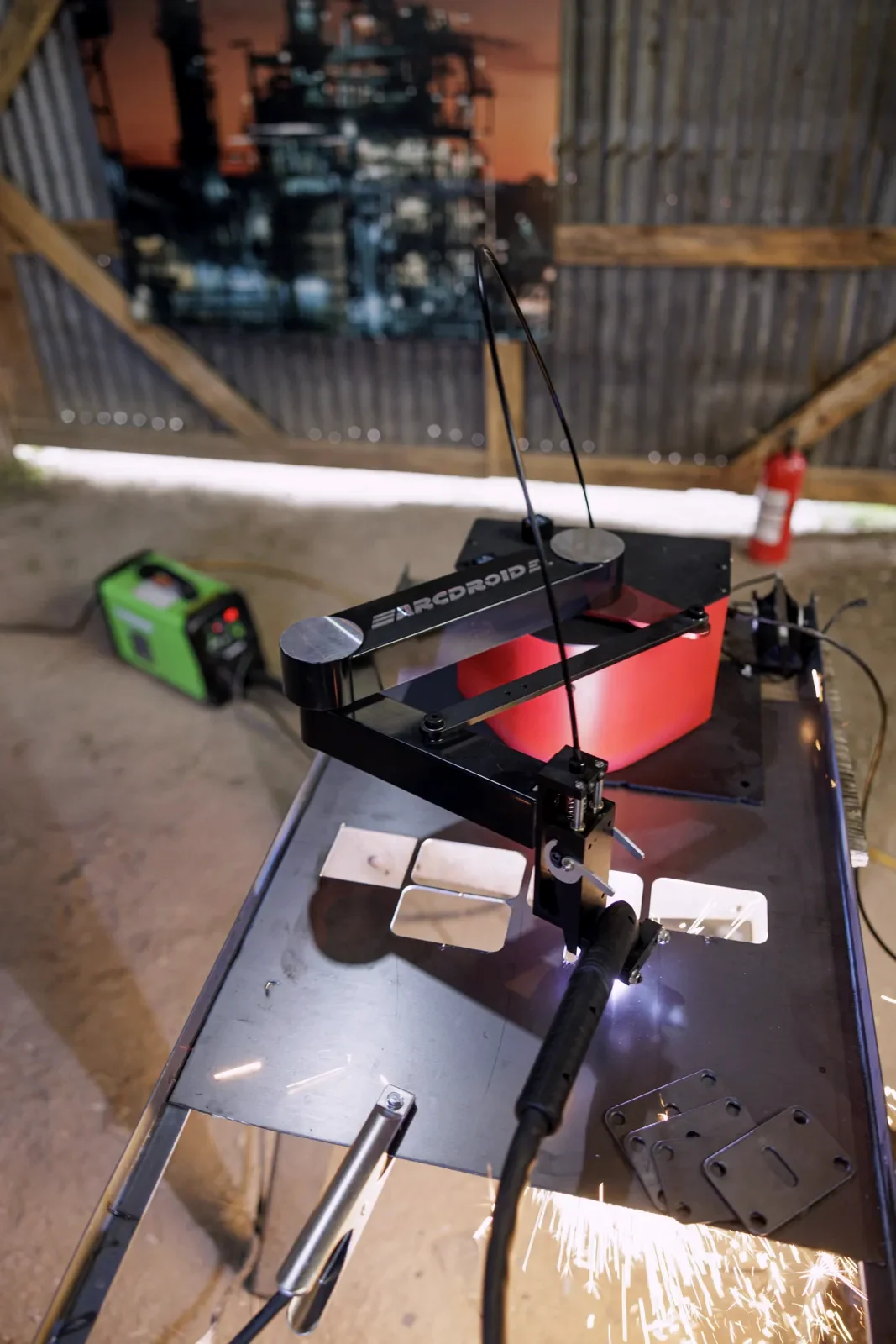
Hypertherm Powermax 45 XP and 65 (the benchmark, consumables everywhere), GYS Néocut 45 / 70 / 105 and Cutter CT, Lincoln Tomahawk 625 / 1000, ESAB PowerCut 900 / 1300, Thermal Dynamics Cutmaster 60i, Everlast PowerPlasma 62i / 82i. Budget: from €900 for an entry-level 45 A pilot-arc unit to €3,000–4,000 for a Powermax 65 with machine torch. All connect to the ArcDroid; the full list is on the Compatibility page.
- Target clean cut: 12 mm → 45 A · 20 mm → 65 A · 25 mm and more → 85–105 A
- Start: pilot arc or touch start, never HF
- CNC output / CPC port for height control
- Air: 200 l/min at 6 bar, dry and filtered